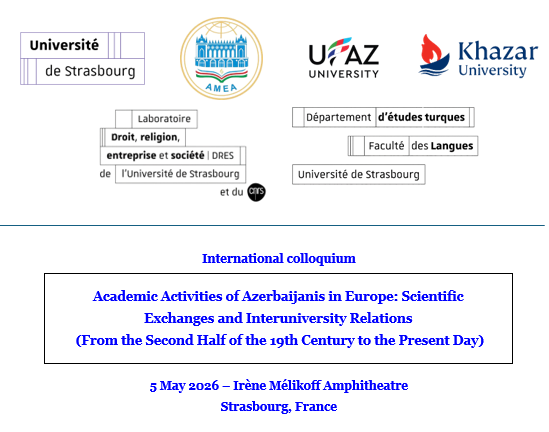
From the second half of the 19th century onwards, scientific exchanges between Azerbaijan and European countries have been part of a long-standing dynamic of knowledge sharing, intellectual development and academic cooperation. At that time, the Azerbaijani region, integrated into the Russian Empire, was participating in the educational and cultural transformations affecting the entire Caucasus. It was in this context that the mobility of students and researchers to European universities, particularly in France and Germany, was encouraged. These exchanges contributed to the emergence of intellectual elites familiar with Western scientific methods, disciplines and trends, while promoting the establishment of transnational academic networks. At the same time, academic exchanges accompanied broader cultural, political and educational transformations. Azerbaijani intellectuals educated in Europe, particularly in Paris and Berlin, as well as at universities in Moscow and Istanbul, played a notable role in debates on alphabet reform, the modernisation of education systems and the emergence of new cultural forms, such as theatre and opera. They also contributed to the emergence of innovative political and legal frameworks, including the creation in 1918 of the Democratic Republic of Azerbaijan, the first secular republic in the East to recognise women's political rights.At the turn of the 20th century, several prominent figures from Azerbaijani literary, cultural and scientific circles, including members of the Shakhtahtinski, Hajibeyli, Toptchibashev, Melikoff and Asadullayev families, continued their activities in Europe. Their integration into European scholarly networks, their publications and their institutional collaborations constituted the first forms of Azerbaijani academic establishment on the continent.Despite the constraints imposed by the Soviet regime, intellectual exchanges did not disappear during the second half of the 20th century. Researchers, translators and academics working in Western Europe helped to maintain an ongoing scientific dialogue. Irène Mélikoff's initiatives played a central role in structuring exchanges between specialists in Turkish and Caucasian studies. The scientific meetings organised in Strasbourg, notably the first France-Azerbaijan symposium in 1984, as well as the institutional collaborations she encouraged, contributed to the consolidation of a transnational academic space.Since the 1990s, in the context of Azerbaijan's independence, the intensification of academic mobility among students, doctoral candidates and researchers towards European universities has renewed these exchanges. The creation of university associations and the development of joint research projects are helping to structure inter-university cooperation and strengthen the integration of young researchers into European academic networks. These dynamics were accompanied by a growing interest in the study of Azerbaijani intellectual trajectories in Europe, notably through the work of Ramiz Abutalibov on intellectual migrations in the early 20th century.Adopting an interdisciplinary approach (history, sociology, diaspora studies, education sciences), this colloquium will bring together contributions aimed at answering the following questions: How have European and Azerbaijani universities established and developed academic relations between Azerbaijan and Europe since the end of the 19th century? How can we now promote their careers and major works, which have long remained unknown? What are the current forms of university cooperation? What prospects do these exchanges offer for the future of research, training and scientific mobility?
In order to answer all these questions, we propose some areas for exploration:
Thematic axes (non-exhaustive):
Azerbaijani student and intellectual mobility in Europe (19th–21st centuries)
Academic and scientific networks between Azerbaijan and Europe
Emblematic figures of the Azerbaijani academic diaspora
The role of European universities in training Azerbaijani intellectual elites
Archives and correspondence: sources on transnational academic exchanges
Bilateral and multilateral cooperation in higher education (for example: Erasmus+, Horizon Europe)
Impact of geopolitical contexts (Russian Empire, USSR, post-independence) on academic exchanges
Submission guidelines:
Interested researchers are invited to submit a proposal for a paper including an abstract (500 to 600 words), accompanied by a brief biographical note (100 to 150 words) or, optionally, a CV.Proposals may be submitted directly via the colloquium platform: https://academic-eu-az.sciencesconf.org/or sent by email to the following address: academic-eu-az@sciencesconf.org
Important Dates:
Submission deadline: 31 January 2026Notification to authors: 1 March 2026Programme publication: 1 April 2026Date of the colloquium: 5 May 2026
Practical information:
Languages of the colloquium: French, EnglishLocation: Strasbourg, FranceVenue: Irène Mélikoff Amphitheatre
Organized by: Tamerlan Quliyev(University of Strasbourg, ITI MAKErS / UMR 7354 DRES)Coordinated by the Department of Turkish Studies at the University of Strasbourg
Scientific Committee:Samim Akgönül Professor, Director of the Department of Turkish Studies, CNRS, UMR 7354 DRESHamlet IsakhanliProfessor, President of the Board of Directors and Supervisory Board of Khazar UniversitySolmaz Rüstamova-TohidiProfessor, Member of the Scientific Council of the Institute of Oriental Studies of the AMEA (Académie nationale des sciences d'Azerbaïdjan)Dilek SarmisAssociate Professor in the Department of Turkish Studies, University of Strasbourg, l'UR 1340 GÉOVazeh AsgarovDoctor of the University of Strasbourg, Vice-recteur de l'ASOIU et Directeur exécutif de l'UFAZTamerlan QuliyevDoctor of Political Science, Qualified for the position of Associate Professor, Postdoctoral Researcher at ITI MAKErS, UMR 7354 DRES
 Loading...